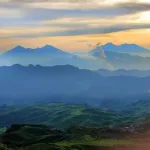
salakhalimunmountain.com – Deep in West Java’s living green lies Mount Halimun: a slow-breathing mountain wrapped in mist, memory, and moss. The Sundanese name itself — Halimun — means “mist,” and here that mist behaves like an old friend, following the ridges, pooling in hollows, and softening the forest light until it feels almost otherworldly. At 1,929 meters above sea level, Halimun stands as a bank of life for three regencies — Sukabumi, Bogor, and Lebak — and as one of Java’s most evocative examples of primary rainforest.
The living forest: sights, sounds, and the pulse of Halimun
Walking into Halimun is sensory immersion. The air is heavy with green perfume — damp leaves, wet earth, and the faint sweetness of decaying wood. Your boot presses into soft mud; spongy moss cushions your step. Sunlight, when it reaches the understory, slices the fog into golden ribbons. Cicadas create a distant, metallic hum; small birds flash colors like secret signals between trunks. Every breath tastes cool and clean.
Flora: ancient trees and delicate life
The forest canopy here is a cathedral of trunks and branches. Lianas loop from tree to tree like natural ropeways. Ferns the size of tea tables spread from shaded banks. Epiphytic orchids and mosses decorate the upper limbs, catching moisture from the ever-present fog. This is prime habitat — not a second-growth patch but fragments of an ancient system that once blanketed much of Java. It is also a living laboratory where subtle ecological relationships — fungus to root, insect to leaf, bird to fruit — remain visible to observant visitors.
Fauna: hidden and remarkable
While many animals remain rarely seen, their presence is everywhere: the soft murmur of forest mammals moving away, a sudden rustle as a bird takes flight, or wings fluttering across a sunlit trail. The park is recognized by international conservation groups for its avian diversity, and butterfly chasers will find seasonal riches. Even small forest snails and unique invertebrates tell the story of an ecosystem that evolved in isolation and deserves careful protection.
Pondok Halimun: a piece of paradise
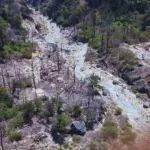
Among the many charms of the mountain is Pondok Halimun — a place many visitors call a slice of heaven. Nestled in Desa Sundajaya Girang, this area combines cool slopes, layered views of surrounding hills, and an impossibly clear river that runs through the camp area. People come here to breathe, to bathe in cold water that smells like stone and rain, and to sleep in simple lodges that lean into the landscape rather than dominating it.
The lodgings in Pondok Halimun — some built in a minimalist Western style close to European cottages — feel gentle against the surroundings. Nights are full of river sounds and insect calls; mornings arrive on mist-softened light. From the ridge above, you can watch clouds roll over the valley like a slow ocean, and sometimes the silhouettes of Mount Salak and Gede–Pangrango appear as twin guardians on the horizon.
History and legend: Prabu Siliwangi’s mountain
Halimun is stitched into Sundanese history and lore. For centuries, the mountain has been a spiritual place. It is widely told that Prabu Siliwangi, the legendary king of the Pajajaran kingdom, used Halimun for meditation, prayer, and retreat. Local tradition remembers him visiting the forest to deepen his spiritual life, seek guidance, and enter seclusion.
The invisible fortress
One of the most enduring tales tells of a royal fortress built by Siliwangi that can only be perceived by the spiritually attuned. The fortress — not readily visible to ordinary eyes — adds a haunting layer to the landscape. Even if taken as myth, the story transforms the forest: every path, every boulder, every clearing can feel like a shrine, a place where history and nature fold into one another.
Trekking Halimun: practical and poetic
Mount Halimun offers trekking that rewards patient walkers. The volcanic stratovolcano terrain produces steep sections and sudden ridgelines where the forest gives way to panoramic air. Because some tracks are steep and unofficial, the mountain is best suited to those who plan carefully and travel respectfully.
Permit and regulations
As part of Halimun–Salak National Park, access requires registration and permits. This is not a bureaucratic hurdle — it is a conservation measure to protect sensitive habitat. Registration is often available online via park channels, and rangers can provide current information. Follow the park’s rules: stay on permitted trails, do not feed or chase wildlife, and carry out all trash.
Typical trekking duration and difficulty
A typical summit trek and return may take up to eight hours depending on the route, pace, and weather. Beginners should take note: some stretches are steep, with loose soil and exposed roots. Trekking poles, good boots, and a steady pace make the climb safer and more enjoyable. Local guides — often drawn from nearby villages — not only show the trail but share stories, plant knowledge, and weather wisdom that enrich the journey.
Access and proximity: close enough for a weekend
One of Halimun’s strengths is its accessibility. The mountain sits approximately 10 kilometers from central Sukabumi — a short drive that makes the mountain ideal for families and groups seeking a refreshing escape. From Sukabumi to some trailheads, the route by road to higher ground usually takes about one to two hours depending on traffic.
For those traveling from Mount Salak or other regional hubs, Halimun sits as a neighboring sentinel — only about 30 kilometers from Salak by road. On clear days, the top of Halimun grants sweeping views of both Mount Salak and the distant Gede–Pangrango massif — a layered reminder of Java’s volcanic spine.
Water, life, and local livelihoods
Halimun is more than a scenic backdrop: it is a hydrological lifeline. Multiple springs burst from the mountain and feed rivers that sustain communities and farmlands downstream. Water is piped from the mountain to supply clean water across three regencies — Bogor, Lebak, and Sukabumi — and the mountain’s streams feed three major rivers: Cisadane, Cidurian, and Ciujung. Standing beside a Halimun spring, you can feel the connection between highland forest health and the lives of people far below.
Responsible trekking: leave only footsteps
Visiting Halimun is a privilege. To keep it that way, follow these principles:
- Register with park authorities and secure necessary permits.
- Stay on marked trails and respect closures.
- Carry out all waste — pack it in, pack it out.
- Do not remove plants or disturb wildlife.
- Use local guides when possible to support communities and gain valuable knowledge.
What to bring
A simple packing list improves the trip: sturdy hiking boots, rain layer, warm mid-layer, trekking poles, refillable water bottle, headlamp, personal medications, and waterproof bags for electronics. A camera or notebook will help you record moments — the way light slices the fog, or the small orchid growing from a crevice.
Visitor information and fees
Entrance fees are modest and help finance conservation: on weekdays local visitors typically pay Rp5.000 while international visitors pay Rp150.000. On weekends and public holidays, the local rate is usually around Rp7.500 and international visitors Rp225.000. Prices and registration processes can change — check with park authorities or official park websites before you travel.
Final reflections: mist, memory, and morning light
Mount Halimun is a place that imprints itself slowly. It is not simply a postcard view; it is a set of senses and a community of stories. Here, every dripping leaf and river stone remembers a different past. The mountain teaches a quiet lesson: the world’s most precious places ask for time, respect, and humility.
So, if you’re ready to explore the wonders of Mount Salak Halimun, head over to our ONLINE BOOKING PAGE and let’s start planning your adventure.
Or simply CLICK THIS LINK to chat with us on WhatsApp.
With our team, you’re not just getting a guide; you’re gaining a local friend who will ensure your trip is nothing short of extraordinary.